Wireless Garage Opener
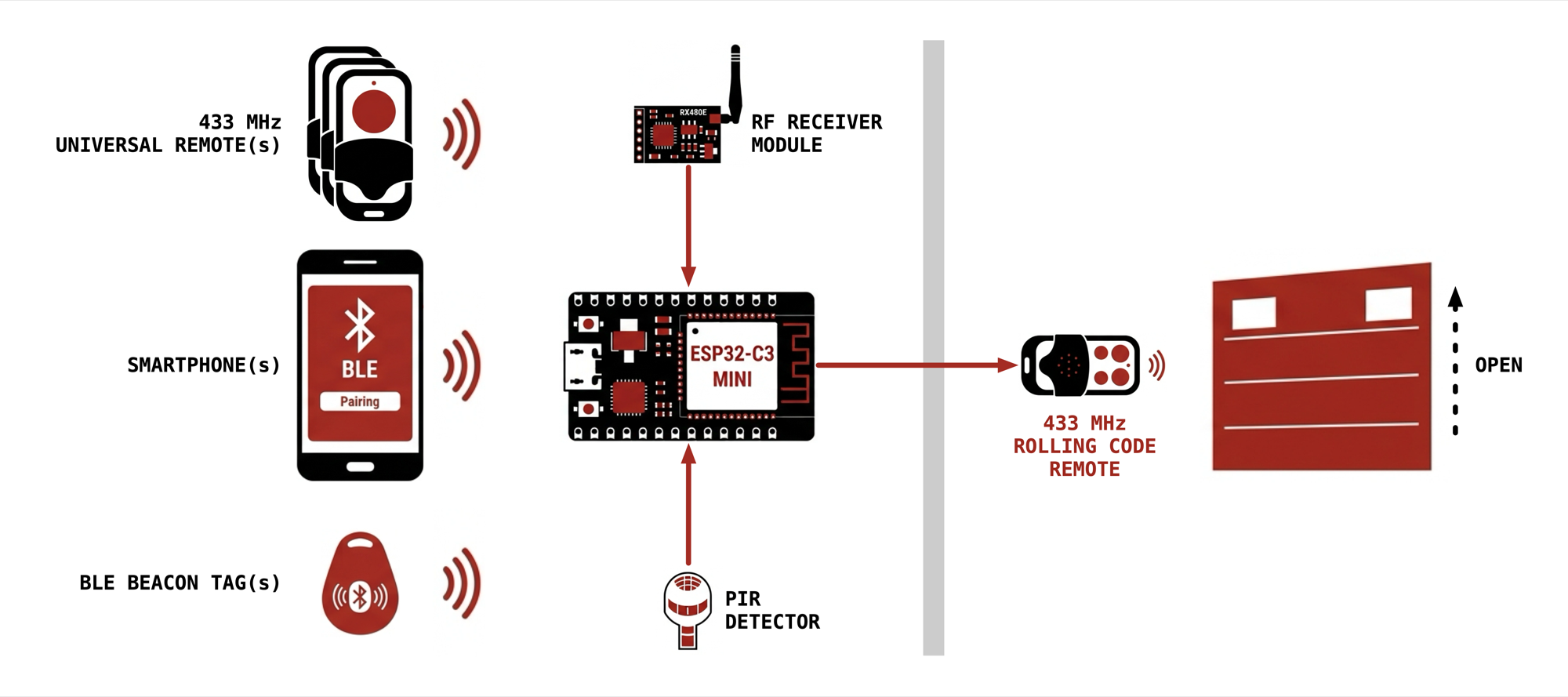
Concept sketch — several possible trigger sources (a 433 MHz universal remote via an RF receiver module, BLE pairing from a phone, BLE beacon tags, and a PIR motion sensor) all converge on one microcontroller, which in turn activates the output side — here, an existing 433 MHz rolling-code remote — to open the door.
The base idea is a general one: any authorized trigger — a remote, a paired phone, a beacon tag, or simply detected presence — is just an interchangeable input on the same board. Swapping or adding a trigger doesn't change the underlying architecture, only which port feeds it.
The 433 MHz remote in the diagram is one such input; it could just as easily be a smartphone or a BLE beacon tag instead. The ESP32 already has a built-in Wi-Fi/BLE radio, so those two paths need no extra hardware — but the universal remote control path needs a separate RF receiver module to pick up its 433 MHz signal.
An ESP32-C3 sits in deep sleep (µA draw) until a PIR sensor wakes it, then opens a window in which a bonded iPhone, a whitelisted BLE beacon tag, or a universal remote control can authorize a relay pulse to open the door.
The original remote control's rolling code can't be replicated, so it has to stay as the final link before the door — reused as-is. Instead of a person pressing its button, the ESP32 simulates that press electrically, bypassing the button entirely.
Major Challenges
- Fully self-contained — the device operates entirely on its own, with no user interaction and no re-flashing required once deployed.
- Deep-sleep wake constraints — the ESP32-C3 stays in deep sleep to extend battery life, woken only by the PIR sensor.
- Unattended authentication — passkey-based pairing ensures only authorized persons can use the device.
- State surviving a full restart — every deep-sleep wake resets the chip entirely (RAM is lost), so bonded phones and the beacon whitelist have to live in flash to persist across cycles.
- One button, three behaviors — hold duration alone distinguishes normal use, teaching a new beacon, and a full factory reset.
Draft placeholder — full write-up and details coming soon.
← Back to iAlmirPro.Home